
How to Find Books
Need to browse our school library catalogue? Would you like to learn more about how our library is organized and how to find the right book? Our helpful guide below will walk you through all this and more.
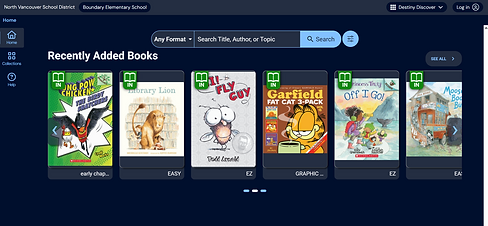

How to Find Non-Fiction Books
Using the Dewey Decimal System
In our library, we use the Dewey Decimal System to help organize the non-fiction books. This system puts books into groups based on what they are about. Each group has a number, so it’s easier to find what you’re looking for!
Here are some examples:
000s – Computers and big ideas
100s – Feelings and thinking
200s – Religions and beliefs
300s – Communities and rules
400s – Languages
500s – Animals, science, and nature
600s – Inventions, health, and cooking
700s – Art, music, and sports
800s – Poems and plays
900s – History and geography
Each book has a Dewey number on its spine, like 595 for insects or 641 for cookbooks. Look for the number on the shelf signs and spine labels to help you find the book you want.
How to Find Fiction Books
Fiction books are stories that come from the author’s imagination—they can be funny, exciting, scary, or mystical.
In our library, fiction books are organized by the author’s last name. That means all the books by the same author are shelved together in A–Z order.
For example:
-
Books by Rick Riordan (The Percy Jackson series) will be in the R section.
-
Books by Suzanne Collins (The Hunger Games series) will be in the C section.
Look at the spine label on the book—it will have an "F" for fiction and the first three letters of the author’s last name.


How to Finding E for Everyone (Picture) Books
Everyone books, also called picture books, are great for all readers who enjoy shorter stories with illustrations.
In our library, Everyone books have an “E” on the spine label, and they are organized by the author’s last name, in A–Z order.
For example:
-
Books by Peter Brown will be in the "B" section.
-
Books by Oliver Jeffers will be in the "J" section.
Look for the “E” on the spine and the first three letters of the author’s last name to help you find your favorite books.
How to Find Graphic Novels
Graphic novels are stories told with pictures and words—like a comic book, but longer. They can be of any genre and can teach you something new through facts or an imagined story.
In our library, graphic novels are shelved in a special section to make them easy to find. Even though they can be fiction or non-fiction, libraries use a special number in the Dewey Decimal System to keep them together.
Look for:
-
The Dewey number 741.5 — this is the number for graphic novels and comics.
-
On the spine label, you'll see 741.5 and the first three letters of the author’s last name.
For example:
-
A graphic novel by Raina Telgemeier will be labeled 741.5 TEL.
We keep all the graphic novels together so it’s easy to browse your favorites.


How to Choose a “Just Right” Book
Finding the perfect book is like finding the perfect pair of shoes—it should fit just right!
Here are a few tips to help you choose:
-
Look at the cover and title — Does it look interesting to you?
-
Read the summary — Does the topic sound fun or exciting?
-
Try the Five-Finger Rule — Read one page. If you find five or more tricky words, it might be too hard right now.
-
Ask yourself — Can I understand what’s happening? Am I enjoying it?
A “just right” book should be fun to read, not frustrating. It helps you grow as a reader while still letting you enjoy the story.
Want to learn more? Check out the video!
